

An organizer does not choose each participant’s hotel. They do decide what participants see first. Distance, shared transport, eco-labeled hotels: 3 practical levers.
A participant books wherever it is easy. If the first thing they see is a hotel 12 km away because it is €8 cheaper, they will take it, then drive back and forth for 3 days.
The organizer does not decide for them. But the organizer chooses which hotels are offered, the order in which they appear and the information shown next to the price. That is where it all plays out, long before the event.
The stakes are real: according to The Shift Project’s report “Décarbonons la culture !”, quoted by the French Ministry of Culture, 88% of spectators drive to a show at a medium-sized venue on the outskirts of a city. The farther the hotel, the more that habit repeats morning and evening.
1. Why show the distance, and not only the price?
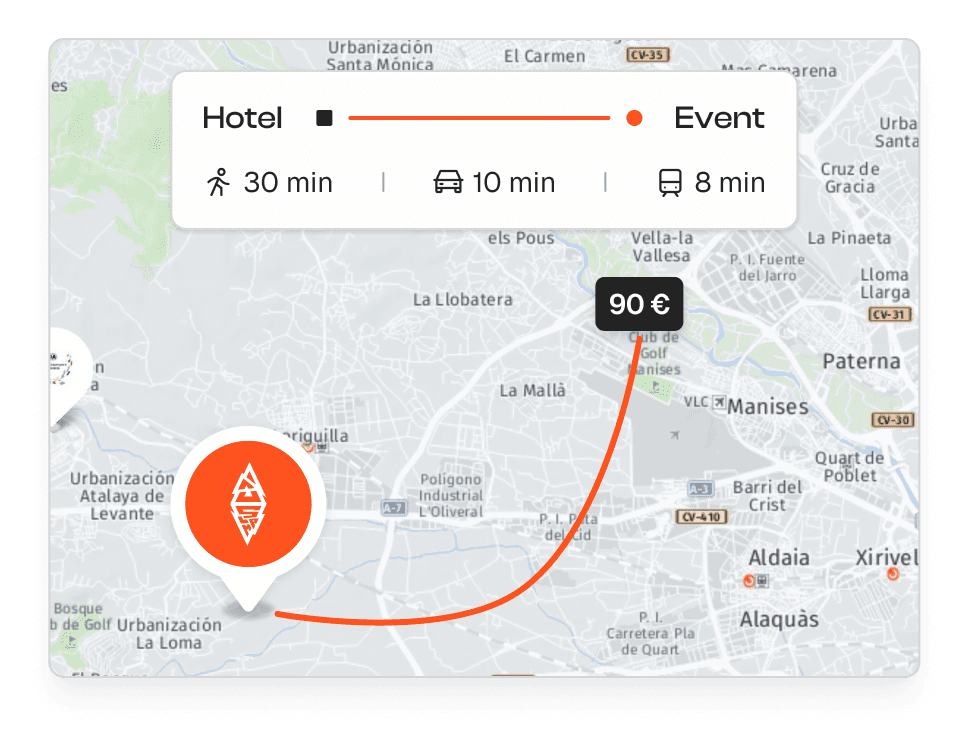
A hotel 600 m from the venue is a walk away. At 6 km, it takes a vehicle, twice a day, for each participant. The difference does not show in a list sorted by rate.
Display the distance between each hotel and the event venue, clearly, next to the price. Participants then do the math themselves: the slightly more expensive room nearby often costs less than a room far away, once the trips are counted.
2. How do you pool the trips that remain?
Not everyone will stay next door. For the others, 2 things help.
First, say how to come without a car: highlight train and bus options to reach the destination, right on the booking page.
Then, share. When you know which hotels participants are staying in, you can set pick-up points and run shared shuttles instead of dozens of taxis. On Revolugo platforms, the organizer can see where participants are staying to define these points. Carpooling between participants completes the set-up.
3. How do you make eco-labeled hotels visible?
Eco-labeled hotels exist in most destinations. They still have to be found. A dedicated filter is enough for a participant who cares to spot them in 2 clicks, without reading 40 listings.
On the organizer’s side, the choice is made upstream: in the selection of partner hotels, favor those with a sustainable approach. These 3 points are part of our commitments.

And a lever people forget: book the right amount
Blocking 300 rooms to fill 220 is good for nobody. Anticipating needs better, group by group, avoids overcapacity and the waste that comes with it. It is forecasting work more than communication, and it is done with the hotelier.
Where to start
Take your last edition. Look at how many participants stayed more than a 15-minute walk from the venue. That is your starting point, and the only figure you need to choose which of the 3 levers to pull first.
Booking the right amount starts with the room list: see what a rooming list should contain. An event to prepare? Let’s talk.
Frequently asked questions
What is sustainable accommodation?
Accommodation that cuts its water and energy use and its waste, and has this checked by a label. The EU Ecolabel and Green Key are among the recognized labels for hotels.
Does accommodation weigh on an event’s carbon footprint?
It weighs notably through the trips it requires. A hotel far from the venue adds two motorized trips per day per participant. Choosing nearby hotels and pooling the remaining trips reduces this.
How do you encourage participants to stay near the venue?
By showing distance and travel time next to each hotel’s price, and listing the closest hotels first. Participants then do the math themselves.
When should shuttles be set up?
When a large share of participants stay too far to walk. Knowing which hotels they sleep in lets you set a few pick-up points instead of multiplying taxis.
Updated on

 Edward Grunwald · 15 June 2026 · 3 min read
 Mathilde Manson · 10 September 2025 · 3 min read